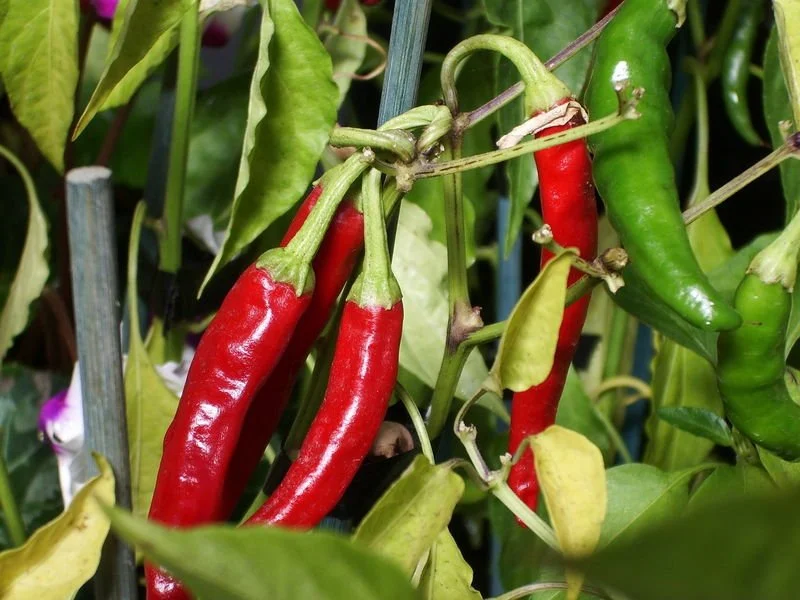
Chilli
Tamil Name: Milagai; Scientific Name: Capsicum annum L., Capsicum frutescens L.;
Planting/Sowing
Jan – Feb; Jun – Jul;
Harvesting
Mar – Apr; Aug – Sept;
First Harvest
~75 Days

Tamil Name: Milagai; Scientific Name: Capsicum annum L., Capsicum frutescens L.;
Jan – Feb; Jun – Jul;
Mar – Apr; Aug – Sept;
~75 Days
| Crop category | Spice |
| Life span | Annual |
| Type of crop | Bush |
| Part(s) of the crop to harvest | Fruit |
| Avg. Height | 60 – 80 cm (up to 2 m) |
Chillies require moderate warm climate to grow well.
When to plant / sow seeds (ideal season):
Jan – Feb; Jun – Jul;
How to plant:
Transplanting;
Seeds to be sprinkled over the nursery bed; soil sprinkled over the spread seeds and seedlings to be maintained up to 30 days. Transplanting of seedlings to be done at 1 seedling per hole and spaced about 60 cm from each other.
NOTE: Please go through the Guides in the Knowledge Base for more details on topics ranging from Spacing & Lighting to Soil and Nutrients.
Irrigate 3 days after transplanting. Irrigate the plants once in 7 days during summer and once in 15 days during rainy season.
NOTE: Irrigation should depend on how moist / wet the soil is. Check your plants everyday to see if they require irrigation or not. Check the Watering & Irrigation guide for more info.
When to harvest
75 days after germination.
How to harvest
First two picking will yield green chillies and subsequent yield will be red ripe fruits.
NOTE: Harvest periods can vary depending on the environmental, climatic, soil conditions.
| Pests | Thrips, Aphids, Tobacco cut worms |
| Common Diseases/ Problems | Damping off, fruit rot, blight, powdery mildew, leaf curl virus |
| Pest and Disease prevention measure(s) | Read Pests & Diseases for more information. |
The Scoville scale (SHU) is a measurement of how ‘hot’ a chilli is. Different varieties of chillies rank from mild to super hot. One of the hottest chillies in the world is the Ghost Pepper (Bhut Jolokia), cultivated in NE India. It scores over 1 million SHUs (400 times hotter than Tabasco), but is still only half as hot as the world’s hottest chili – the Carolina Reaper.
Crops by Expertise

 © RavichandraCluster Beans
 © Ctg4Rahat
 © Judgefloro
 © Tanuj Handa
 © Adityamadhav83
 © Chinmayee Mishra
 © Mac Choo
 © Anubhab shil
 © Laura Melchor
 © Andresmh
 © Sandeep Handa