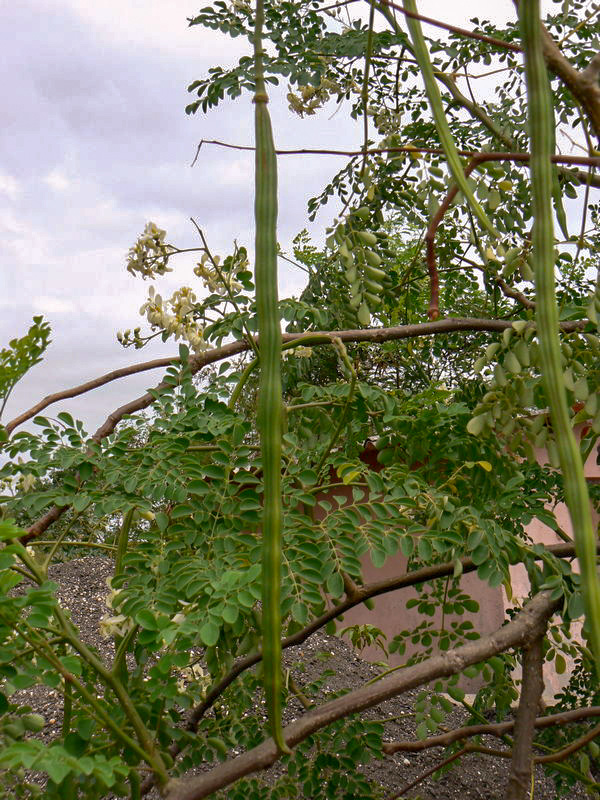
Drumstick (Moringa)
Tamil Name: Murungakkai; Scientific Name: Moringa oleifera;
Planting/Sowing
Jun – Jul; Nov – Dec;
Harvesting
Dec – Jan; May – Jun (following year);
First Harvest
~180 Days

Tamil Name: Murungakkai; Scientific Name: Moringa oleifera;
Jun – Jul; Nov – Dec;
Dec – Jan; May – Jun (following year);
~180 Days
| Crop category | Vegetable |
| Life span | Perennial |
| Type of crop | Tree |
| Part(s) of the crop to harvest | Pod, Leaves |
| Avg. Height | 12-15 m |
Moringa thrives in tropical and semi-tropical conditions.
When to plant / sow seeds (ideal season):
Jun – Jul; Nov – Dec;
How to plant:
Direct Sowing: Two seeds are sown 3 cm deep in each pit in the centre of a container / on the ground. Seeds typically germinate 7-9 days after sowing.
Moringa may also be grown from cuttings. Branches of an existing tree are cut and then placed in the ground. The size of the branches should be around 1m long, and 4cm in diameter. Water regularly till it takes root.
Pits of 3cm deep dug at 2.5 m x 2.5 m.
NOTE: Please go through the Guides in the Knowledge Base for more details on topics ranging from Spacing & Lighting to Soil and Nutrients.
Moringa is a drought resistant tree and does not require much watering. During dry months, water regularly for the first few months and then only when required, based on plant condition.
NOTE: Irrigation should depend on how moist / wet the soil is. Check your plants everyday to see if they require irrigation or not. Check the Watering & Irrigation guide for more info.
Pruning must be done when the plant is 10 to 12 m long and can take place on a regular basis following harvest.
The tree may also be cut back annually to 1 to 2 meters and regrown in order to keep fruits and leaves within arm’s reach.
NOTE: See the Pruning guide for general info.
When to harvest
Starts bearing fruits from the 6th month onwards.
How to harvest
Harvest when pods are young and snap easily (about 1 cm in diameter). Harvest the pods before they split and the seeds fall to the ground.
NOTE: Harvest periods can vary depending on the environmental, climatic, soil conditions.
| Pests | Mites, hairy caterpillars, leaf miners, termites |
| Common Diseases/ Problems | Diplodia root rot |
| Pest and Disease prevention measure(s) | Mulching with castor oil leaves / ash; |
NOTE: Read Pests & Diseases for more information.
Nearly all parts of the Moringa tree are edible and have medicinal uses. The leaves, immature seed pods, mature seeds, oil, flowers and even roots all may be eaten. Moringa is being touted as ‘the superfood of superfoods’ because of its nutritional and antioxidant properties. Moringa seedcakes are also an important water purifier and are used as a non-toxic, sustainable water purifying agent.
(For first 3 years)
Crops by Expertise
 © Nirajan Pant
 © Chinmayee MishraHoly Basil
 © balouriarajesh
 Tatiana Volgutova
 © Anubhab shil

 © Daniela Kloth
 © Forest & Kim Starr
 © iKLICK
 © Dinesh Valke