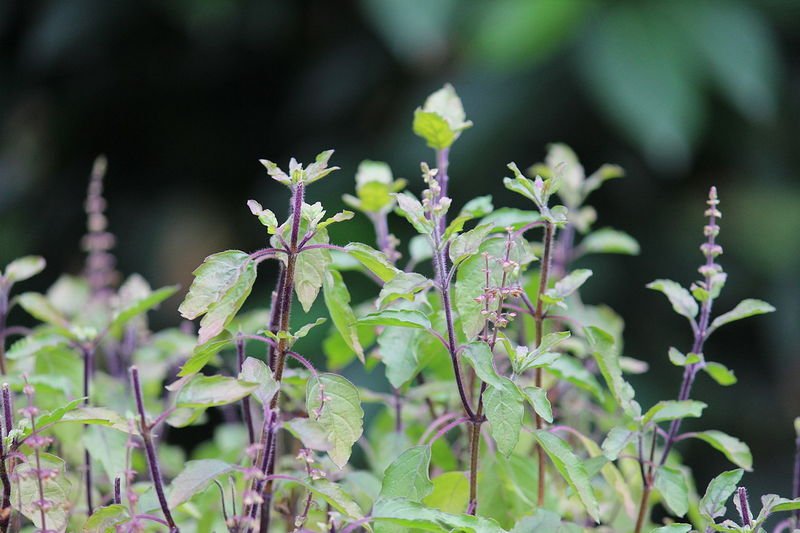
Holy Basil
Tamil Name: Tulasi; Scientific Name: Ocimum sanctum;
Planting/Sowing
Oct – Dec;
Harvesting
Jan – Mar;
First Harvest
~90 Days

Tamil Name: Tulasi; Scientific Name: Ocimum sanctum;
Oct – Dec;
Jan – Mar;
~90 Days
| Crop category | Herb |
| Life span | Perennial |
| Type of crop | Shrub |
| Part(s) of the crop to harvest | Leaves |
| Avg. Height | Up to 1 metre (3.3 feet) in height |
Grows well in Tropical and subtropical climate. Long days with high temperature have been found favorable for plant growth and oil production.
When to plant / sow seeds (ideal season):
October to December
How to plant:
Direct sowing of seeds: Sow in nursery beds located in partial shade with adequate irrigation. Soil is worked up to a depth of 30 cm. Well rotted farm yard manure is applied to the soil and prepared to a fine tilth and seed beds of 4.5×1.0x0.2 m size are prepared.
Cuttings: Tulsi can also be propagated by vegetative method using terminal cuttings. Cuttings with 8-10 nodes and 10-15 cm length are used. Except for the first 2-3 pair of leaves the rest are trimmed off. Plant in well prepared nursery beds or polythene bags. In about 4-6 weeks time the rooting is complete and they are ready for transplanting.
Seeds have to be sown at a depth of 1/4 inch below soil; as the seeds are minute, the required quantity of seeds are mixed with sand in the ratio of 1:4 and sown in nursery bed 2 months in advance of the onset of monsoon; they germinate in 8-12 days and seedlings are ready for transplanting in about 6 weeks time at 4-5 leaf stage.
NOTE: Please go through the Guides in the Knowledge Base for more details on topics ranging from Spacing & Lighting to Soil and Nutrients.
Irrigation is provided twice a week till one month so that plants establish themselves well. Later, it is given at weekly intervals, depending upon the rainfall and soil moisture status.
NOTE: Irrigation should depend on how moist / wet the soil is. Check your plants everyday to see if they require irrigation or not. Check the Watering & Irrigation guide for more info.
Tulsi needs to be periodically pruned, leaving behind at least five inches of growth, so that the plant can still flourish. Regular pruning not only encourages more growth, but also promotes a more rounded shape.
NOTE: See the Pruning guide for general info.
When to harvest
The first harvest is done after 90 days of planting and subsequently it may be harvested at every 75 days interval. The crop is harvested at full bloom stage by cutting the plants at 15 cm from ground level to ensure good regeneration for further harvests.
How to harvest
Use small garden shears or sharp scissors; harvest from the top of the plant and work your way down; cut either a few leaves or a whole branch depending on how much you need. Handle leaves carefully, the leaves can bruise easily damaging the scent or flavour. Harvest only when you need them, as once harvested, the leaves can fade quickly. The easiest way to harvest the seeds is to carefully cut the spent flower heads off the plant and put them somewhere warm and dry for a few days. You can then crush the heads and collect the seeds.
NOTE: Harvest periods can vary depending on environmental, climatic, and soil conditions.
| Pests | Aphids, mealy bugs, spider mites, Leaf roller |
| Common Diseases/ Problems | Powdery mildew, seedling blight, root rot |
| Pest and Disease prevention measure(s) | Avoid getting water on the leaves when watering, as damp leaves can be a breeding ground for mold and disease; Organic pesticide will cure most infestations. Neem oil and soap mixture is used to control Aphids. |
NOTE: Read Pest & Disease Control for more information.
Apart from it’s many well known medicinal properties and religious uses, dried tulsi leaves can be mixed in with stored grains like rice and lentils to keep away insects.
Crops by Expertise
 © Dinesh Valke
 © JoydeepEggplant
 © gardenhunt
 © seedsofindia
 © Ravichandra
 © Chris and Kelly
 © Castielli
 © Nirajan Pant
 © Sandeep Handa
 © Chinmayee Mishra
 © Korkeng